A general secular news list with posts and discussion of news and other media items related to atheist, church-state separation, effects of religion, etc. Archives are public and membership is not restricted. The list is maintained by District of Columbia Atheists, Inc UNICUM is a free, Hungarian and English language electronic program magazin serving the Metropolitan Washington area with dissemination of Hungarian cultural/social events, local news, announcements, concerns
Join IKAM Productions and Black Women Film Network (BWFN) as a kick-off Happy Hour & Networking as we bring more events and activities to the DMV. Bring your ideas!
Thursday, November 13, 2025, 5 pm - 7 pm at The Gathering Spot - DC
IKAM Productions is excited to bring BWFN to the DMV. From educational events to screenings, BWFN delivers content and information that makes an impact for all filmmakers.
Come to the Happy Hour to network with other filmmakers, learn about upcoming BWFN programming, and have some fun!
*Complimentary appetizers for the first hour or while supplies last!
Who is Black Women Film Network?
Established in 1997, the Black Women Film Network (BWFN) was founded to prepare black women to enter the film and television industries.
--
He/she who takes a chance, who walks the line between the known and the unknown, who is unafraid of failure, will succeed. - Gordon Parks
May every day be the beginning of an endless self discovery and adventure......whether you like it or not. Embrace it and soar! - H. Taha
-- -- gal`va`nize: to stimulate people into sudden activity; to provide a network for DC metropolitan theatre artists, specifically those of the African diaspora, in order to connect, support and encourage each other because "we are all far too beautiful to be so seen so little".
Csatlakozz hozzánk az év legnagyobb adománygyűjtő rendezvényén, ahol vár rád:
🍽️ Hagyományos magyar ételek
🎶 Élő magyar népzene és Táncház a Flaska Bandával
🛍️ Magyar termékek, kézműves áruk, könyvek
🎯 Gyerekprogramok és játékok egész nap
👋 Barátok, közösség és ünnepi hangulat
Ez a népszerű éves esemény, ami a cserkész szülők önkéntes munkája, több száz embert hoz össze, hogy együtt hangolódjunk az ünnepekre, és ápoljuk a magyar hagyományokat!
💖 Támogass bennünket!
A bevétel a washingtoni magyar cserkészcsapatot támogatja.
A jelenléted és adományod teszi lehetővé a rendezvényt!
2 doboz Bogyó és Babóca társasjátékot szívesen postáznék (postaköltség kb $10) vagy Sterlingben, VA - megbeszélt időpontban átvehetők fizetés után. Venmo, Zelle, Készpénz fizetéssel.
On Sunday, October 5, 2025, 10:07 AM, 'Prandovszky Emese' via Unicum <unicum@googlegroups.com> wrote:
Emlékeztető, hogy ma du. 4-5 megint lesz tánc a Kossuth házban, de a mai furulyaoktatás sajnos elmarad, mert fellépésünk van a zenekarral.
Várlak benneteket szeretettel.
There will be children dance again today from 4–5 p.m. at the Kossuth House. Unfortunately, the flute lesson will be canceled because we have a performance with the band. Looking forward to seeing you all!
On Monday, September 22, 2025, 3:56 PM, 'Prandovszky Emese' via Unicum <unicum@googlegroups.com> wrote:
Below in English.
Kedves Szülők,
Most vasárnap (szept. 28) ismét elkezdődik az Iciri-Piciri gyermek néptánc és népzene oktatás a Kossuth Házban, ahova várjuk a gyerekeket 3 és 12 év között. A foglalkozásokra havonta kétszer kerül sor vasárnaponként az alábbi időpontokban.
A néptánc oktatásba az idei KCSP ösztöndíjas, Soma, is besegít majd. A népi furulya oktatást du. 3-4, míg a táncot du. 4-5 között tartjuk.
Kérlek, regisztráljatok erre az email címre (prandovszkye@yahoo.com)küldött válaszban a gyerkőc nevét és korát megjelölve, akkor is ha az első alkalmon nem tudtok résztvenni.
A soron következő Kossuth házas Iciri-Piciri oktatás időpontjai: szeptember 28; október 5, 19, 26; november 9, 16;
Az őszi évadban a Cserkész bazárra (Nov. 22.) készülünk majd.
Várom kérdéseiteket, javaslataitokat.
Üdvözlettel,
Emese
Tisza Együttes táncosa
Szikra banda furulyása
---------
Dear Parents,
The first Iciri-Piciri children's folk dance and folk music class will take place this Sunday in the Kossuth House. Children ages 3 to 12 are welcome. We will meet twice a month on Sundays, dates are listed below. Soma the KCSP scholar will help out with the folk dance teaching. The folk recorder class will be from 3-4 pm, followed by folk dance from 4 to 5 pm. Please register by replying to this email (prandovszkye@yahoo.com) with your child's name and age.
Dates of the next Kossuth house Iciri-Piciri classes: September 28th; October 5th 19th, 26th; November 9th, 16th;
In the autumn season, we will prepare for the Cserkész bazaar (Nov. 22rd ).
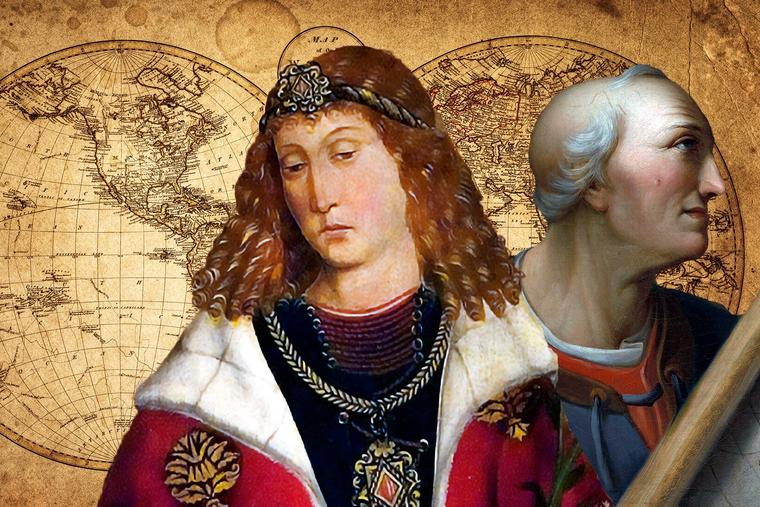
In a new piece for the National Catholic Register BFP Alumnus Luke Larson explores how the name 'America' may trace its roots not just to Amerigo Vespucci — but further back to Saint Emeric of Hungary ("Imre"/"Emericus"), the 11th-century Hungarian prince whose name echoes across continents and centuries.
Left: Detail of St. Emeric from a 1478 painting in the Church of Spišská Kapitula, Slovakia. Right: Charles Willson Peale, "Amerigo Vespucci," 1816, National Portrait Gallery, Washington, D.C. (photo: Wikimedia Commons / Public Domain)
America is named after Amerigo Vespucci, the Italian explorer who first argued that Columbus had discovered not just a new passageway to Asia, but an entirely new continent.
But where does Amerigo Vespucci's name come from?
There may be a surprising Catholic answer to that.
While not known for certain, many scholars believe Amerigo Vespucci's name — and thus America's name — can be traced back to St. Emeric, an 11th-century saint from Hungary.
Emeric, son of Hungary's first Christian king, St. Stephen, was born around A.D. 1000. His name is translated as Imre in Hungarian, Emericus in Latin, and Amerigo in Italian.
Devotion to Saint Emeric was widespread in medieval Europe, including in Vespucci's native Italy.
Vespucci grew up in Florence, the epicenter of the Renaissance, and worked as a banker and later supervisor of ships for the famed Medici family, the patrons of da Vinci, Michelangelo and Galileo. A triptych (three-panel altarpiece painting) in the San Martino a Mensola chapel just outside Florence includes an image of Amerigo d'Ungheria, St. Emeric of Hungary, depicted as per custom holding a white lily. The image — painted by an artist named Amerigo Zati 60 years before Vespucci's birth — is strong evidence that Florentians of Vespucci's day knew St. Emeric well and would have named children in his honor. Emeric of Hungary is the only saint to bear the name Emeric.
Vespucci himself was a Catholic and was tutored by his uncle Georgio Antonio Vespucci, a Dominican friar. The name "America" — an homage to Vespucci's voyages to the coast of South America — was first used in 1507 on a map of the New World produced by Father Martin Waldseemüller, a German priest and scholar. The map is sometimes referred to as "America's birth certificate." Despite attempts to name the new landmass "Columbia," after Christopher Columbus, the name America stuck.
As a member of Hungary's "holy family," Emeric lived a life surrounded by saints. His father, St. Stephen, converted from paganism and devoted his life to bringing his people to the Catholic faith. His mother is Blessed Gisela, daughter of Holy Roman Emperor St. Henry II. His tutor, St. Gerard, was a Benedictine monk and bishop who died a martyr's death at the hands of pagans in what is today the city of Budapest.
While just one generation removed from paganism, Emeric was an extremely devout Christian.
He hoped to become a priest, but he set aside this vocation when he became heir to the Hungarian throne following the death of his older brother. His father planned to eventually hand over the kingdom to Emeric during his lifetime. He wrote The Admonitions, a list of advice for his son on how to govern as a wise Christian ruler.
Stephen's counsels to young Emeric, as rendered in a 2025 Latin-to-English translation of the text, include the following:
"Hold steadfast to the Catholic and apostolic faith with such diligence and care that you set an example to all subjected to you by God."
"He who scorns the principles of his fathers who have gone before him and disobeys divine laws shall perish."
"Patient kings rule with honor, and impatient kings become tyrants."
"The constant pursuit of your life [should] be devotion to the Ten Commandments. A king must be pious and merciful, as well as imbued and adorned with all the other virtues."
Emeric married a princess, likely from the Byzantine Empire, in 1026. Biographies of his life relate that he was killed by a wild boar while hunting in Transylvania in 1031. Many speculate, however, that he was assassinated.
Because of his young age at death, he is venerated in Hungary as the patron saint of Hungarian youth.
"For almost a thousand years, Hungarian youth have an ideal," said Venerable Cardinal József Mindszenty, Hungary's famous communist-era archbishop, in a 1972 sermon. "[He is] a most beautiful model to follow, from whom married people as well as young people can learn, for he humbled himself and lived his religious life with total dedication."
He remains an important saint for Hungarians and Hungarian Americans. St. Emeric's in Cleveland is the only church in America that bears his name. Historically, Cleveland has had the highest concentration of Hungarian immigrants of any major American city. The parish still offers one weekly Sunday Mass in Hungarian. St. Emeric's parish in Manhattan, named in honor of Cardinal Mindszenty, was closed in 2013. At Our Lady of Hungary parish in South Bend, Indiana, St. Emeric is depicted in a large mural with sword in hand standing next to a map of North America and the eagle from the seal of the United States.
Emeric was canonized along with his father Stephen and his tutor Gerard by Pope Gregory VII in 1083. His feast is celebrated throughout the universal Church on Nov. 5.
Luke Larson Luke Larson is a native of Saint Paul, Minnesota currently working in Washington, D.C. His background includes research work at the Mathias Corvinus Collegium in Budapest, Hungary and two years of seminary formation at the Saint Paul Seminary. He is a graduate of Minnesota State University.